THIS TIME OF year, the burden of all the serious arguments and disagreements left over from Thanksgiving dinner melt deliciously into a far more congenial controversy, which plays out at every ice-cream shop in the land:
Do you prefer a cake cone, waffle cone, or a sugar cone?
If you’re partial to the wafer-like texture and subtle flavor of the cake cone, especially after it’s become slightly soggy with melted ice cream, you’re certainly not alone. And the bold cookie flavor and crunch of a sugar cone has many fans too — although most Americans, given a choice, go for the generous size and luxuriant crispness of a waffle cone, sometimes dipped in chocolate.
No matter what your preference, though — unless it’s hand-rolled using homemade dough — your favorite cone is the great-great-grandchild of the first mass-produced ice cream cone that dropped out of a brand-new machine invented and fabricated in Portland, Oregon, circa 1912 — the brainchild of a creamery executive named Frederick A. Bruckman, in collaboration with his boss, George Weatherly.
BRUCKMAN AND WEATHERLY didn’t invent the concept of an ice cream cone. Their role was more like the one Henry Ford played in automobile history: They took a product that had formerly been made painstakingly by hand, and automated its production.
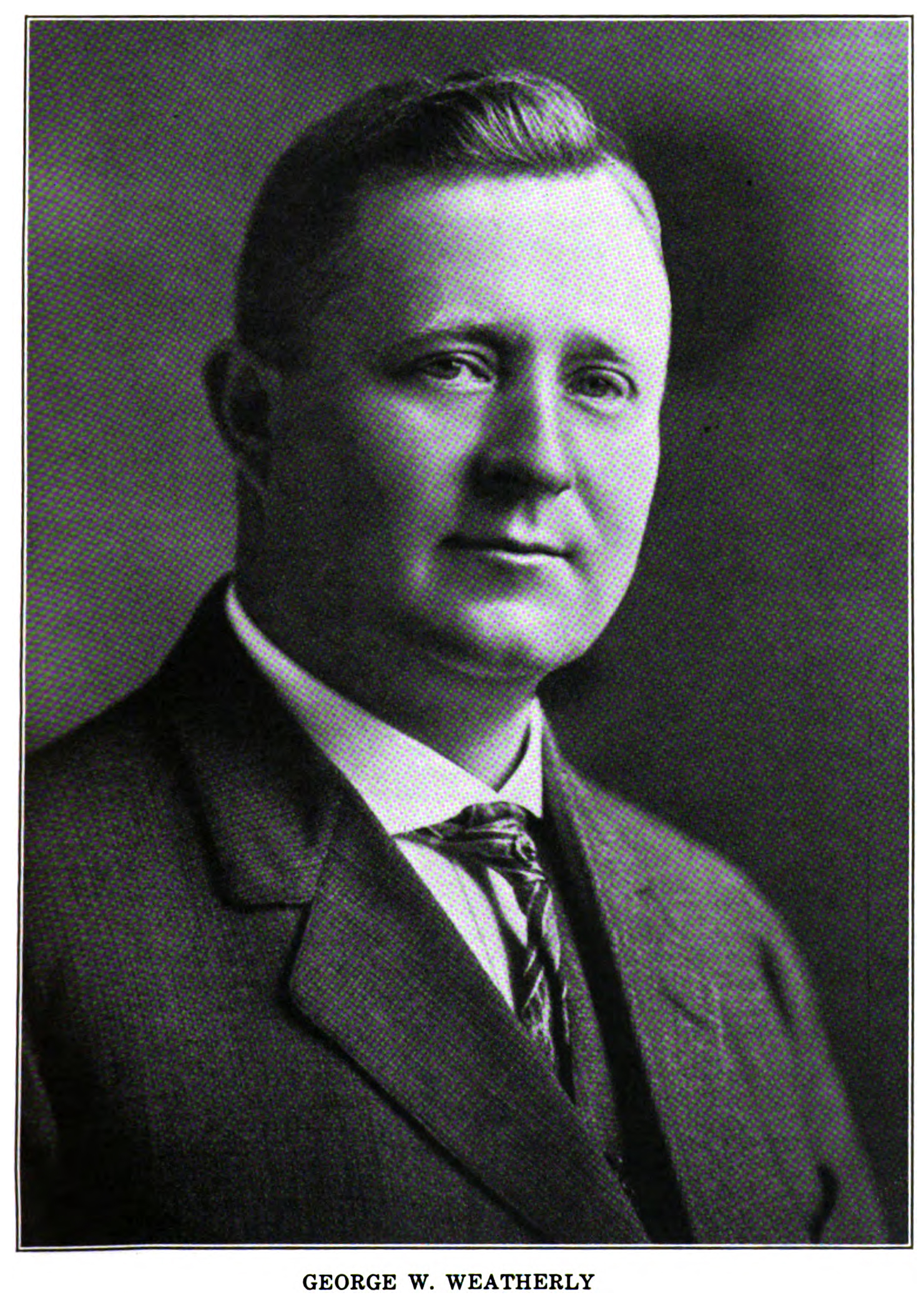
George Weatherly as he appeared in the late 1920s, just about the time he was going into the pheasant business. (Image: S.J. Clarke Publishing)
Bruckman was the primary inventor. He was a creamery man from Illinois who’d moved to Portland in 1906, and taken a job with Weatherly’s company, the Weatherly Creamery Co.
Weatherly was an Oregon boy who’d grown up on a farm in Pleasant Valley (now a neighborhood of east Portland). In 1892 he’d bought a small confectionery store on the corner of Martin Luther King Jr. avenue (then called Union Avenue) and Morrison Street, in east Portland. And that’s how he got into the premium ice cream business.
This was long before refrigeration was a thing, of course. Ice cream was a rare treat, and it was made the old way, by melting ice with lots of salt to cool it to below freezing and agitating a mixture of cream, sugar, flavorings and add-ins while it froze.
Weatherly started out making the stuff with a hand mixer, feeding it with ice he bought from Crystal Ice and Storage Co., a local outfit that cut ice from caves near Mount Adams and shipped them down the Columbia River, insulating them with sawdust, for Portlanders to use to cool their beverages in the heat of summer.
Demand for Weatherly ice cream soon outstripped what George could supply with his hand mixer, and he upgraded his equipment again and again. Soon he was running a small wholesale ice cream sales operation, and not long after that, it was no longer so small. By 1900 wholesale profits dwarfed what he was making in his confectionery store, so he sold it and concentrated on ice cream.
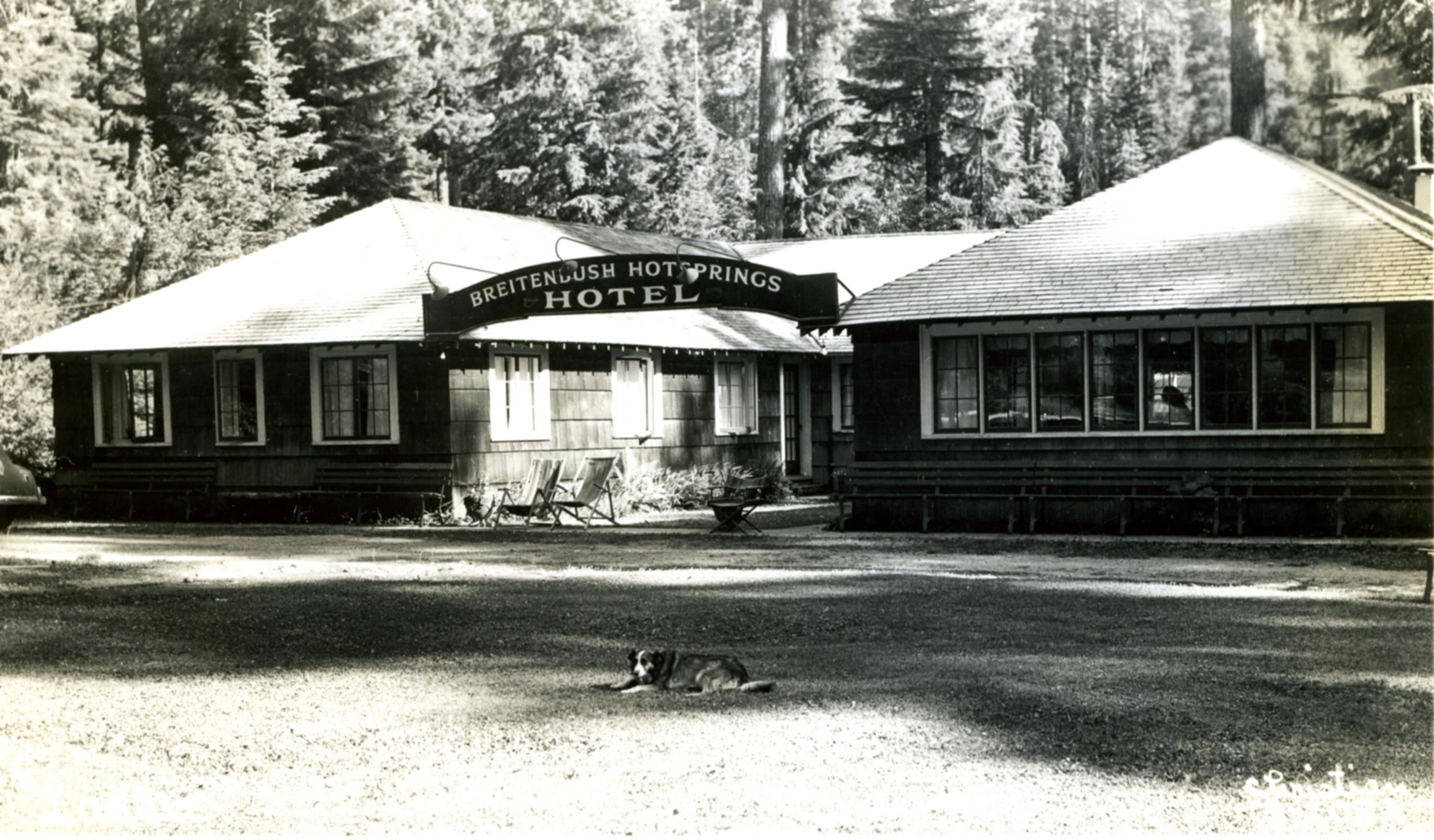
Breitenbush Hot Springs lodge as it appeared in the mid-1950s, during the time the Bruckman family owned it. (Image: OSU Libraries)
In 1907 Weatherly Creamery Co. merged with Crystal Ice and Storage, but continued selling Weatherly brand ice cream.
Meanwhile, of course, Weatherly had hired Bruckman, and Bruckman brought with him an obsession with eat-it-all cones. Knowing very well that a machine-built cone would yield tremendous synergies for his ice cream sales, Weatherly encouraged Bruckman in his quest and probably financed some of his research and development too.
Working with Weatherly apparently in a sort of informal partnership, Bruckman launched the Pacific Coast Cone Co. in 1908, several years before he perfected his cone-making machine; and he threw himself into the quest. He’d sampled a number of hand-made ice-cream cones and cone-like contrivances at various world fairs and expositions over the previous few years, and found some (but by no means all) of them quite tasty; but the process of making them just wasn’t scalable. What was needed was a steam- or electric-powered machine capable of making hundreds of cones per hour, so that they would be “within reach of the child who had only an occasional nickel to spend for sweets,” as he put it in a 1917 interview with Western Confectioner Magazine.
The problem was getting the cones to drop out of the machine without human intervention. One night he watched his wife making timbale crusts — baking a batter carefully in a cup-shaped mould, picking it carefully out before adding filling — for refreshments at a card party she was hosting the following day. She carefully picked the crusts out of the little molds, taking exquisite care that they should remain perfect. Now, he mused, how can I automate that?
He also watched the construction of one of the bridges across the Willamette River — food historian Heather Arndt Anderson observes that this was probably the Hawthorne Bridge, which was built in 1910 — and it gave him the idea of using a cross-hatch “waffle” pattern to strengthen the cone. The pattern would cause the cone to stick in the mould — and solving that problem led him to the major breakthrough, which was a two-piece mould that would pull away automatically, letting the finished cone drop right out.
[EDITOR'S NOTE: In "reader view" some phone browsers truncate the story here, algorithmically "assuming" that the second column is advertising. (Most browsers do not recognize this page as mobile-device-friendly; it is designed to be browsed on any device without reflowing, by taking advantage of the "double-tap-to-zoom" function.) If the story ends here on your device, you may have to exit "reader view" (sometimes labeled "Make This Page Mobile Friendly Mode") to continue reading. We apologize for the inconvenience.]
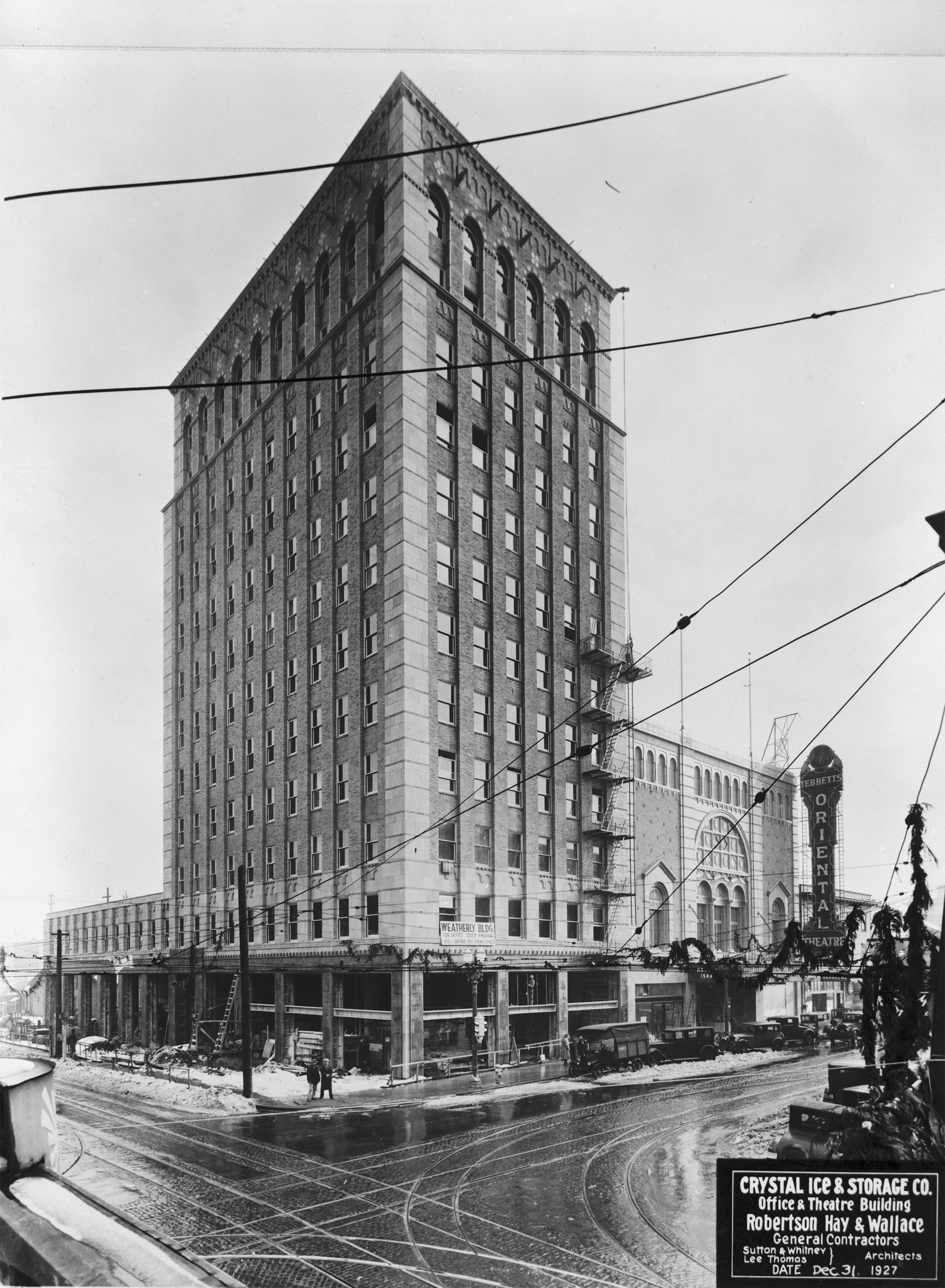
The Weatherly Building during the final phases of construction. The Oriental Theatre, which Weatherly also had built at the same time, opened on December 31, 1927, so this photo was taken on its opening day. The theatre has since been demolished, but the Weatherly Building remains an eastside landmark. (Image: National Parks Service)
Another aspect of Bruckman’s cones is less discussed in the historical record, but it was clearly a huge factor in his success: The flavor profile of his cone batter. Put simply, it was very nearly perfect, right from the start. We can’t be far off in attributing the recipe to Bruckman’s wife, Hettie May (Drais) Bruckman. Someone who makes her own timbale cases, with such exquisite care, for a card party the following day, is clearly no mean pastry chef. For a creamery engineer like Bruckman to get the pastry recipe as right as he did on the first go — and mind you, that recipe is still in use to this day! — would be nearly inconceivable.
In any case, get it right they did, and finally, on July 20, 1912 — 103 years to the day from the time of this writing — Bruckman and Weatherly jointly filed the patent on the world’s first machine-made ice cream cone.
And then, of course, having the protection of an applied-for patent, they went directly into business — lots of business. By 1915 they were cranking out nearly 1 billion cones a year from their factory.
BOTH WEATHERLY AND Bruckman were well-off business owners already. But the invention of the cone machine made both of them stupendously wealthy.
A box of Nabisco’s Comet ice cream cones. Comet sugar cones are reportedly still made with Bruckman’s original recipe. (Image: Nabisco)
Bruckman retired in 1919, and moved into a Tudor-style mansion on Mount Tabor. Later, he and Hettie May moved to eastern Marion County to help their son Merle develop Breitenbush Hot Springs Resort near Detroit. After Hettie May died in 1940, Bruckman married his childhood friend Harriet Eliza Ross, a nationally famous artist and doll designer. They ran Breitenbush as a family until 1956, when it was sold.
In 1958, Frederick Bruckman died at age 85 in a nursing home in Salem.
As for Weatherly, he had an even more eventful “second act.” In 1925, his company merged with Western Dairy Products of Seattle, and Weatherly basically retired from regular involvement, staying on as chairman of the board at Western. At the same time, he turned to a real-estate development project, which resulted in the 12-story Weatherly Building, which still stands today on the same spot where his little confectionery store was at the start of his ice-cream adventure.
After that, Weatherly tried an experiment with pheasant farming, setting up a small operation on two acres near Multnomah. The market for these toothsome gamebirds turning out to be tolerably strong, he limbered up his check-writing hand and dove into the business on a huge scale.
He and some investors bought 100 acres at Springdale, east of Troutdale along the Columbia River Highway, and started raising pheasants by the truckload there. He called the place Weatherly Farms.
Most of the pheasants they raised at Weatherly Farms ended up on dining tables at places like The Arlington Club, Multnomah Hotel, and Meier & Frank’s Georgian Room. Many were also shipped to other cities around the West.
Weatherly died of a stroke in 1948 at age 80, and was buried in Rose City Cemetery.
I MENTIONED THAT the original ice-cream cone recipe, which was likely crafted by Hettie May Bruckman, is still in use today. In 1925, Nabisco bought out Bruckman and Weatherly’s patent for the cone machine, and put it to good use cranking out “Comet” brand cones. These are still in stores today, and several years ago Saveur Magazine named the Comet America’s best-tasting sugar cone.
So, next time the ice-cream bug bites you, you know what to do!
(Sources: “Did You Know Portland Invented the Ice Cream Cone Machine?”, an article by Heather Arndt Anderson published in the May 2019 issue of Portland Monthly; “Portland Pioneer George W. Weatherly Did Everything Big -- Even Ice Cream,” an article by John Terry published June 11, 2011, in the Portland Oregonian; “The Romance of the Ice Cream Cone,” an article by Florence F. Fisher published in the September 1917 issue of Western Confectioner; History of the Columbia River Valley Volume 3, a book by Fred Lockley published in 1928 by S.J. Clarke; findagrave.com)
Background image is a postcard, a hand-tinted photograph of Crown Point and the Columbia Gorge Scenic Highway. Here is a link to the Offbeat Oregon article about it, from 2024.
Scroll sideways to move the article aside for a better view.
Looking for more?
On our Sortable Master Directory you can search by keywords, locations, or historical timeframes. Hover your mouse over the headlines to read the first few paragraphs (or a summary of the story) in a pop-up box.